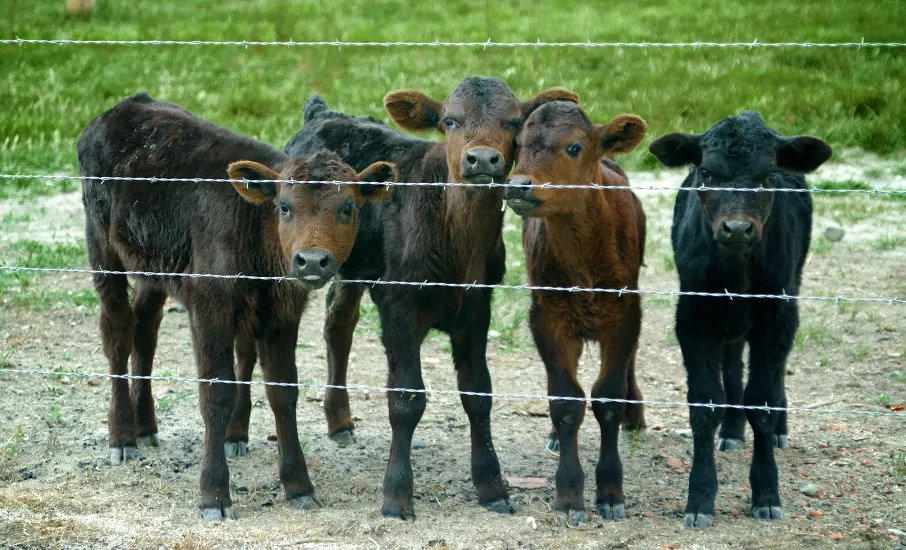
What Is a Barbed Wire Fence?
Barbed wire fence is a fencing structure in which barbed wire is used as the main material for forming the perimeter line. The simplest version of such a fence consists of supports and several rows of tensioned wire placed at the required height. This construction does not create a solid panel, but it marks the boundary of the territory, restricts access and forms a basic physical obstacle.
A barbed wire fence is used where a relatively inexpensive fence is required for a long section: on utility areas, technical zones, agricultural land, temporary sites or auxiliary perimeters. In the barbed wire section, this option can be considered one of the simplest ways to use classic wire in fencing structures. At the same time, it should be understood that such a fence has a limited level of protection and does not replace modern Egoza barriers on sites with increased security requirements.
Construction of a Barbed Wire Fence
The main elements of such a fence are supports, tensioned barbed wire and fastening components. The supports may be metal, concrete or wooden, depending on the purpose of the site, perimeter length, expected service life and load. Barbed wire is tensioned between supports in one or several rows, while tensioning elements, staples, brackets and auxiliary fixing wire are used to stabilize the structure.
Different types of material may be used for a barbed wire fence. Single-strand barbed wire is suitable for simple and auxiliary solutions where availability and quick installation are the main priorities. Double-strand barbed wire holds tension better and has higher mechanical strength. For outdoor use, galvanized barbed wire is usually used, while PVC-coated wire may be selected when colour or additional metal protection is important.
Where a Barbed Wire Fence Is Used
A barbed wire fence is appropriate on sections where a solid fence is not required, but the boundary must be marked, access must be restricted or a simple obstacle must be created along the perimeter. It may be used on agricultural land, utility areas, warehouses, technical zones, temporary construction sites, auxiliary perimeters and long sections where installation of a more complex fencing structure is not economically justified.
Such a fence may also be used as a temporary solution or as part of a simple perimeter with minimal security requirements. Its effectiveness depends on height, number of wire rows, support strength, tensioning quality and correct fastening. If a warehouse, enterprise, infrastructure facility or site with an increased risk of intrusion must be protected, classic barbed wire is usually not sufficient.
Barbed Wire Fence and Reinforcement of an Existing Fence
A barbed wire fence should not be confused with a fence on which barbed wire is installed only as an additional element. In the first case, barbed wire forms the main structure of the perimeter. In the second case, it is used to reinforce an existing fence, concrete barrier, metal sections or another base. Both options may use the same material, but they differ in construction and level of protection.
If barbed wire is installed only on the upper part of a fence, it creates an additional deterrent effect and makes quick climbing over the structure more difficult. If the fence consists entirely of rows of barbed wire, its main task is to mark the boundary and create a basic obstacle on a long section. For critical sites, this option often requires reinforcement or replacement with more modern solutions.
Barbed Wire Fence and Egoza Barriers
A classic barbed wire fence works as a basic access restriction, but its protective capabilities are limited by the construction of the material itself. The barbs are fixed to one or two wire bases, and the perimeter line remains relatively simple to affect mechanically. Such a structure can be damaged, pulled apart, cut or crossed much faster than a three-dimensional or dense barrier made of razor wire.
If a perimeter that is more difficult to cross is required, Egoza concertina wire should be considered. It forms a three-dimensional barrier, has a larger number of cutting elements and creates a stronger deterrent effect. For compact reinforcement of the upper part of an existing fence, an Egoza flat barrier may be appropriate, while Egoza razor mesh may be used to protect the fence plane or the lower part of the perimeter.
Installation of a Barbed Wire Fence
Installation begins with marking the perimeter line, selecting supports and determining the number of wire rows. On long sections, it is important to correctly calculate the distance between supports so that the wire does not sag or lose shape under tension, wind or mechanical load. The supports must be strong enough, especially at corners, near gates, at direction changes and on sections with differences in height. These zones most often become weak points when installation is carried out without prior planning.
Barbed wire is tensioned gradually, with tension uniformity and fastening reliability carefully controlled. During work, protective gloves, thick clothing and tools that allow the wire to be held and tensioned safely must be used. For long sections, it is advisable to divide the perimeter into separate segments to make tension easier to control and avoid overloading the supports. More information about this work is available on the page about barbed wire installation.
Price and Selection of a Barbed Wire Fence
The cost of a barbed wire fence depends on perimeter length, number of rows, wire type, structure height, support material, coating type, fastening method, installation complexity and delivery conditions. The same section may require different quantities of materials depending on fence height, support spacing, number of horizontal rows and durability requirements.
If materials for a simple barbed wire fence are needed, the wire type, number of rows, supports and fastening method should be selected first. For utility and auxiliary areas, this may be sufficient. If the site requires more reliable protection, it is advisable to compare a classic barbed wire fence with modern Egoza barriers. They require a different calculation, but provide a significantly higher level of obstacle for industrial, infrastructure, restricted-access and commercial sites.