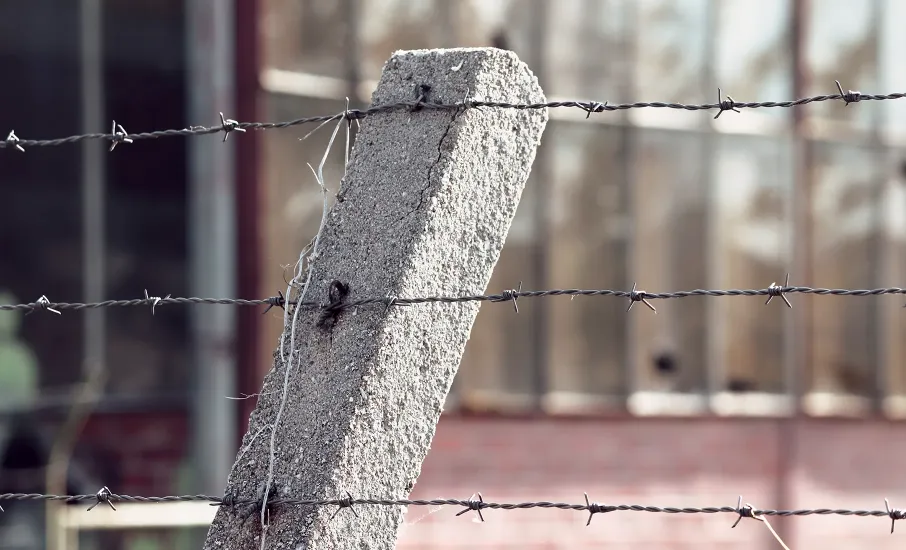
Why Proper Barbed Wire Installation Matters
Barbed wire installation determines how effectively a fence will perform its protective function. Even good-quality wire loses practical value if it sags, is poorly fixed, has excessive gaps between supports or can easily be pulled aside. For simple utility, technical and auxiliary perimeters, it is important not only to choose the right type of wire, but also to install it correctly along the entire fence line.
Barbed wire may be used as the main element of a fencing structure or as additional reinforcement on the upper part of an existing fence. The barbed wire section presents different types of this material, but the principle of installation always comes down to several key requirements: a strong base, even tensioning, reliable fastening, safe work procedures and correspondence between the structure and the actual task of the perimeter.
Preparing the Perimeter for Installation
Before installation, the section where barbed wire will be mounted must be assessed. It is important to determine the perimeter length, the type of main fence, the condition of supports, terrain, the presence of gates, technical passages, corners and areas with difficult access. If the wire is installed between separate supports, their spacing and method of fixation in the ground must be selected correctly. If it is installed on the upper part of an existing fence, the strength of the structure and the possibility of mounting brackets should be checked.
At the preparation stage, the number of wire rows, installation height, tensioning direction and joining points are also determined. For long sections, reliable end and corner supports are especially important, because they take the main load during tensioning. If these points are weak, the wire will sag over time, and the entire fence will look unstable and perform worse.
Choosing Wire, Supports and Fastening Components
Different types of material may be used for installation. Single-strand barbed wire is suitable for simple and auxiliary fences where availability and quick installation are the main priorities. Double-strand barbed wire has higher rigidity, holds tension better and is usually more appropriate for long sections. For outdoor use, galvanized barbed wire is often used, while PVC-coated barbed wire may be selected where colour or additional metal protection is important.
Supports may be metal, concrete or wooden, but they must correspond to the expected load and operating conditions. Staples, brackets, tensioning elements, fixing wire and other components are used for fastening. At corners, near gates and on sections where the direction changes, reinforced fastening should be provided, because these are the points where tension creates the greatest load on the structure.
Tensioning and Fastening Barbed Wire
Barbed wire is tensioned gradually, with evenness checked along the entire length of the section. It should not sag, but excessive tension is also undesirable because it can deform supports, damage fastening components or create a dangerous situation during work. For long fence lines, it is better to divide the perimeter into separate sections so that tension and fixing quality can be controlled more easily.
If the wire is installed in several rows, equal spacing between the rows should be maintained and gaps that are easy to cross should be avoided. When installed on the upper part of a fence, the brackets, their angle and the method of fastening to the main structure must be selected correctly. On the finished line, the wire should form a stable protective contour, not merely a formal addition that can be pushed aside or removed without significant effort.
Safety During Installation
Working with barbed wire requires caution. The barbs can injure hands, face, clothing and exposed areas of the body, especially when the coil is being unwound, tensioned and fixed to supports. Installation should be carried out with thick gloves, protective clothing, eye protection and tools that allow the wire to be held at a safe distance. Work should not be done in a hurry, and long sections should not be tensioned without assistance.
Special attention should be paid to the storage and transportation of coils. The wire must be fixed so that it cannot unwind uncontrollably or create a hazard for people nearby. If installation is performed on an operating site, the work area should be restricted, personnel should be warned, and loose wire sections should not be left in passages, near gates or in areas where vehicles move.
Barbed Wire or Egoza Barriers
Classic barbed wire is suitable for simple fences, auxiliary perimeters and sections where basic access restriction is required. However, its capabilities are limited by its construction: the wire does not create a three-dimensional barrier, has lower obstacle density and can be crossed faster than modern barriers made of razor wire. For this reason, on sites with increased security requirements, not only barbed wire installation should be considered, but also the installation of Egoza concertina wire.
If the upper part of a fence must be reinforced compactly, an Egoza flat barrier may be appropriate. If the fence plane or the lower part of the perimeter must be protected, Egoza razor mesh should be considered. The choice depends on the task: for simple boundary marking, barbed wire may be sufficient, while for more complex protection of industrial, infrastructure, restricted-access and commercial sites, Egoza barriers are more practical.
Installation Cost and Choice of Solution
The cost of barbed wire installation depends on perimeter length, number of rows, wire type, support material, access difficulty, fastening method, condition of the existing fence and the amount of preparation work required. If the wire is used only on the upper part of a fence, the estimate is calculated one way; if it is the main element of the fencing structure, supports, tensioning elements, fastening and a larger scope of work must also be considered.
Before selecting materials and installation method, the actual task of the perimeter should be defined. For a utility or auxiliary area, classic barbed wire may be sufficient. If a warehouse, enterprise, technical zone or site with increased security requirements must be reinforced, it is advisable to compare the cost of ordinary wire with Egoza barriers. In many cases, the more expensive solution provides a significantly higher level of obstacle and better corresponds to the purpose of the site.