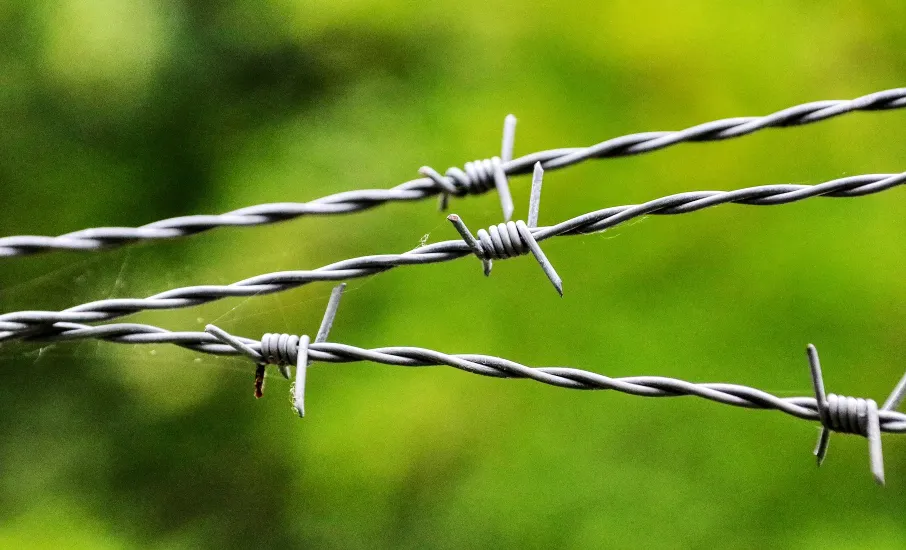
What Is Galvanized Barbed Wire?
Galvanized barbed wire is classic barbed wire with a zinc coating that protects the steel against corrosion during outdoor use. It is used for simple fences, utility areas, technical areas, warehouses, temporary sites and auxiliary perimeters where it is necessary to mark a boundary, restrict access or reinforce the upper part of an existing fence. Thanks to its combination of simplicity, availability and resistance to weather exposure, galvanized wire remains one of the most common options among traditional fencing materials.
In the barbed wire section, the galvanized version can be regarded as a basic solution for outdoor use. It does not have a decorative polymer layer like PVC-coated barbed wire, but it is well suited to technical fences where practicality, durability and moderate cost are important. At the same time, even high-quality galvanized barbed wire remains a traditional material and does not provide the same level of protection as modern barriers made of razor wire.
Construction of Galvanized Barbed Wire
Galvanized barbed wire consists of a steel base and barbs fixed at regular intervals. Depending on the construction, it may be single-strand barbed wire or double-strand barbed wire. The single-strand version is simpler and lighter, while the double-strand version has higher rigidity, holds tension better and usually keeps its shape longer on extended sections.
The zinc coating is applied to the metal to protect it from moisture, precipitation and the corrosive effect of the external environment. The service life of the wire depends on the thickness of the zinc layer, steel quality, diameter of the main wire, barb construction, operating conditions and correct installation. If the wire is constantly in contact with moisture, soil, an aggressive environment or has damaged coating, corrosion may appear sooner, so it is important to consider not only the fact of galvanizing, but also the actual conditions of use.
Where Galvanized Barbed Wire Is Used
Galvanized barbed wire is used for fences around utility areas, agricultural land, warehouses, technical zones, construction sites, industrial sites with basic perimeter requirements and private territories where simple access restriction is needed. It may be tensioned between separate supports, used in several rows or installed on the upper part of a fence as an additional deterrent element.
This solution is appropriate where a long fence line must be arranged at moderate cost or an existing structure must be reinforced without complex installation. However, galvanized barbed wire has limitations: it does not create a three-dimensional barrier, has no razor tape and can be crossed faster than Egoza barriers. Therefore, for warehouses, enterprises, restricted-access territories, infrastructure facilities and sections with increased security requirements, Egoza concertina wire should be considered.
Galvanized Wire or PVC-Coated Wire
Galvanized barbed wire and PVC-coated wire solve similar tasks, but differ in the construction of the protective layer. The galvanized version has a metallic zinc coating that protects the steel against corrosion and is suitable for most technical fences. PVC-coated wire has an additional polymer sheath that may improve the appearance, make the fence less visible and further isolate the metal from the external environment.
The choice depends on operating conditions. For utility, technical and auxiliary perimeters, good-quality galvanized wire is often sufficient. If the fence is located in a visible place, must have a specific colour or operates in a more humid environment, polymer coating may be considered. At the same time, the PVC layer requires more careful installation, because mechanical damage to the sheath reduces its protective function. Therefore, selection should take into account not only price, but also durability, appearance, fastening method and the risk of damage during installation.
Installation of Galvanized Barbed Wire
Installation of galvanized barbed wire requires correct tensioning, strong supports and reliable fastening. The wire must not sag, shift excessively or have sections that can easily be pulled aside. Metal, concrete or wooden supports, tensioning elements, brackets, staples, fixing wire and other components are used for installation. The number of rows depends on fence height, site purpose and the required level of access restriction.
If galvanized barbed wire is installed on the upper part of a fence, the strength of the main structure, condition of the supports, spacing between fastening points and the possibility of safe maintenance must be taken into account. On long sections, it is important to maintain the same tension along the entire perimeter line so that the wire does not sag and lose its working shape. General installation principles are described on the page about barbed wire installation.
Price and Selection of Galvanized Barbed Wire
The price of galvanized barbed wire depends on the diameter of the base wire, number of main strands, thickness of the barbs, spacing between them, quality of galvanizing, coil length, order volume and delivery conditions. For simple fences, the key parameters are sufficient strength, corrosion resistance, ease of installation and suitability for operating conditions. On open sites, special attention should be paid to coating quality, because it largely determines the durability of the fence.
Before buying galvanized barbed wire, it is necessary to define the real task: marking a boundary, restricting access to a utility area, reinforcing the upper part of a fence or creating a more reliable protective perimeter. For basic tasks, galvanized wire may be sufficient. If a higher level of protection is required, it should be compared with modern Egoza barriers, which create a three-dimensional or denser obstacle and are better suited to sites with increased security requirements.