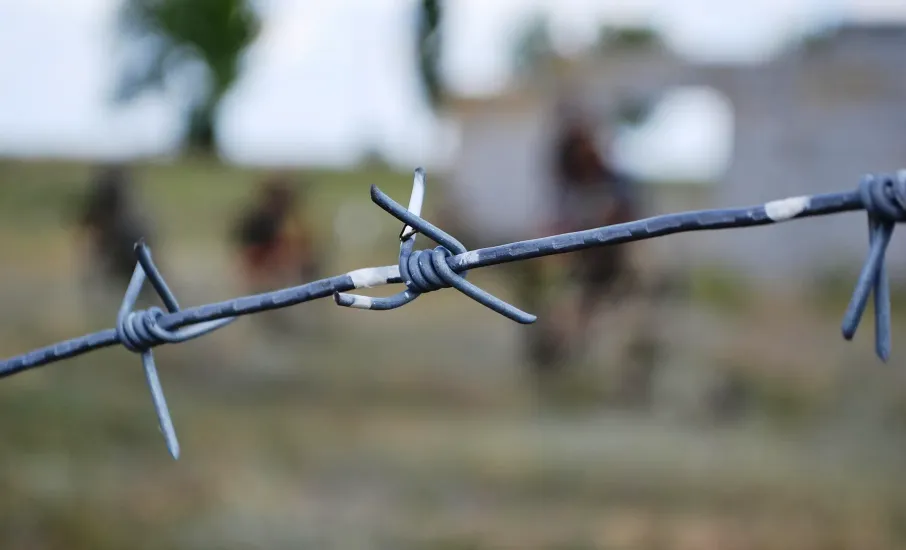
What Is Single-Strand Barbed Wire?
Single-strand barbed wire is a classic type of barbed wire in which the base is one load-bearing steel wire with evenly spaced barbs. This material is used for simple fencing of territories, marking plot boundaries, restricting access by people or animals and reinforcing the upper part of an existing fence. The construction of single-strand wire is simple, which is why it remains one of the most understandable and accessible solutions for basic perimeter protection tasks.
Unlike double-strand barbed wire, the single-strand version has only one load-bearing wire, so it is inferior in rigidity and resistance to mechanical load. At the same time, it is lighter, easier to transport and install, and may be sufficient for many auxiliary fences. If a site requires a higher level of protection, ordinary barbed wire should not be considered the main solution; modern Egoza barriers made of razor wire are more appropriate.
Construction of Single-Strand Barbed Wire
Single-strand barbed wire consists of one steel base wire and barbs fixed to it at regular intervals. The barbs are made from short pieces of wire that wrap around the main strand and create an obstacle on contact with the fence. The protective properties of this material depend on the diameter of the main wire, the thickness of the barbs, the spacing between them, the quality of the metal and the type of corrosion protection.
For outdoor use, the wire must have sufficient corrosion protection, because the fence is constantly exposed to precipitation, moisture, temperature changes and mechanical load. The most common solution is galvanized wire, although polymer-coated versions may be used in certain cases. More information about the differences between these solutions is available on the pages about galvanized barbed wire and PVC-coated barbed wire.
Where Single-Strand Barbed Wire Is Used
Single-strand barbed wire is used where a basic fence must be arranged relatively quickly and at low cost. It may be used on agricultural land, utility areas, temporary sites, technical zones, warehouses, auxiliary perimeters or areas where the main task is to mark a boundary and create a primary obstacle. It is often tensioned in several rows between supports or installed at the top of a fence as an additional element.
At the same time, single-strand wire should not be regarded as a complete solution for sites with high security requirements. It may make casual access or simple crossing of the fence line more difficult, but it does not create the same level of obstacle as concertina or flat barriers made of razor wire. For warehouses, enterprises, infrastructure facilities, restricted-access territories and sites with an increased risk of intrusion, a more practical solution is usually Egoza concertina wire.
Advantages and Limitations of Single-Strand Wire
The main advantages of single-strand barbed wire are simplicity, low weight, availability and straightforward installation. It is convenient to transport, unwind, tension between supports and use on long sections where a complex engineered security system is not required. For agricultural, utility or temporary fences, this may be a rational solution, especially when the main purpose is not maximum protection, but access restriction and boundary marking.
The main limitation of the single-strand construction is lower strength compared with double-strand wire and significantly lower effectiveness compared with Egoza barriers. A single base wire holds its shape less effectively, depends more on the quality of tensioning and may be more vulnerable to mechanical impact. For this reason, on critical sites, single-strand barbed wire should be considered only as an auxiliary or budget option, not as the main element of serious perimeter security.
Installation of Single-Strand Barbed Wire
Installation of single-strand barbed wire requires even tensioning and reliable fastening to supports. If the wire sags, has too large a spacing between fixing points or is attached to weak posts, its protective properties are noticeably reduced. Metal, concrete or wooden supports, tensioning elements, staples, brackets and auxiliary fixing wire are used for installation. The number of rows is determined according to fence height, site purpose and the required level of access restriction.
During installation, safety must be observed, because even ordinary barbed wire can cause injuries. Work should be carried out in thick gloves, protective clothing and with tools that allow tension to be controlled without accidental contact with the barbs. For long sections, the position of supports, tensioning direction and joining points should be planned in advance. General installation principles are described on the page about barbed wire installation.
Price and Selection of Single-Strand Barbed Wire
The price of single-strand barbed wire depends on the diameter of the main wire, the thickness of the barbs, the spacing between them, coating type, coil length, order volume and delivery conditions. For simple fences, the key parameters are sufficient strength, corrosion resistance and ease of installation. If the wire is used outdoors, particular attention should be paid to the quality of the coating, because it largely determines the service life of the fence.
Before buying single-strand barbed wire, it is necessary to determine whether it matches the actual task. For basic fencing, an agricultural plot or an auxiliary perimeter, this solution may be sufficient. If a higher level of protection is required, it should be compared with double-strand wire or modern Egoza barriers. In many cases, Egoza concertina wire will be a more expensive but much more effective solution for sites where the real difficulty of crossing the perimeter matters.