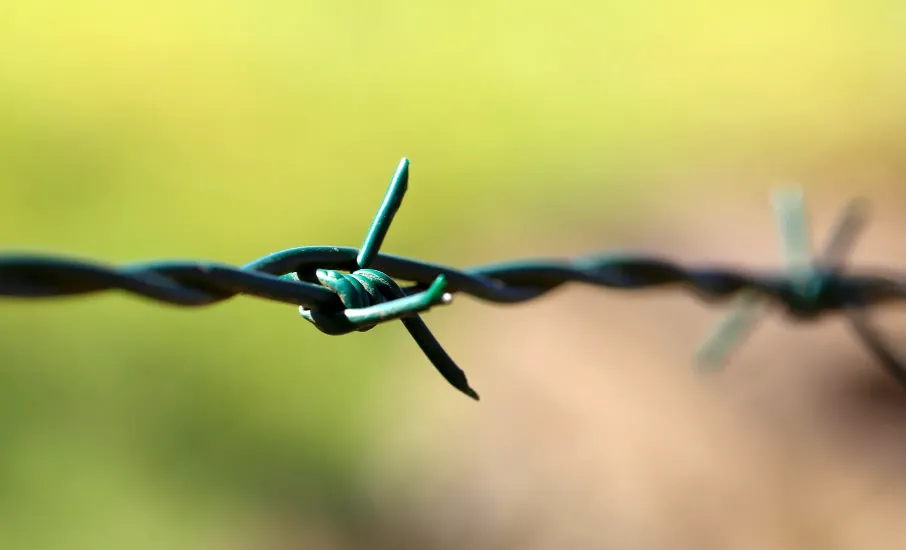
What Is PVC-Coated Barbed Wire?
PVC-coated barbed wire is classic barbed wire with a polymer coating applied over the metal base. PVC protects the steel from direct contact with moisture, precipitation and some aggressive external factors, and also changes the appearance of the fence. This type of wire is most often used where not only basic access restriction is required, but also a more restrained appearance of the fencing structure.
By purpose, this material belongs to the general group of barbed wire, but differs from ordinary galvanized wire by having an additional polymer layer. PVC coating may be green, black, brown or another colour, depending on the manufacturer and the task. This makes the wire less visible against a metal fence, vegetation or a technical area, although in terms of protection it still remains classic barbed wire, not a modern Egoza barrier.
Construction of Barbed Wire with Polymer Coating
The basis of this product is a steel wire or several wires on which wire barbs are fixed. Depending on the construction, it may be single-strand or double-strand barbed wire. After manufacturing, the metal part is covered with a PVC layer that forms a protective sheath. The quality of this coating is important: it should be uniform, without cracks, gaps or areas where the metal remains exposed.
The protective properties of the wire depend not only on the presence of PVC, but also on the diameter of the metal base, construction type, quality of galvanizing under the polymer layer, coating thickness and operating conditions. If the polymer is damaged during transport or installation, the metal may lose its additional protection in those areas. For this reason, PVC-coated barbed wire requires careful handling, correct tensioning and fastening without unnecessary damage to the sheath.
Where PVC-Coated Barbed Wire Is Used
PVC-coated barbed wire is used for fencing utility areas, technical areas, warehouses, private perimeters, auxiliary zones, industrial sites and areas where a neater fence appearance is important. It may be tensioned in several rows between supports, installed on top of an existing fence or used as an additional element where access must be restricted without installing a complex engineered security system.
The polymer coating is especially appropriate where the fence is located in a visible place or should stand out less against the surrounding environment. Green barbed wire is often chosen for areas near vegetation, while black or brown wire is used with dark metal structures. At the same time, it should be understood that colour and additional coating do not change the basic protective effectiveness of classic wire. For sites with increased security requirements, Egoza concertina wire should be considered.
PVC Coating or Galvanized Barbed Wire
Compared with galvanized barbed wire, the PVC-coated version has an additional outer layer that protects the metal and affects the appearance of the fence. Galvanized wire is simpler, often less expensive and sufficient for many technical or utility areas. Polymer-coated wire is selected when longer service life in more difficult conditions, lower visibility or colour matching with the main fence is more important.
At the same time, PVC coating has its own limitations. It must be protected from serious mechanical damage during installation, sharp bending, friction against sharp elements and careless tensioning. If the coating is damaged, the advantage of the polymer layer is partly lost. Therefore, the choice between galvanized wire and PVC-coated wire should take into account not only price, but also operating conditions, appearance, expected service life and installation method.
Installation of PVC-Coated Barbed Wire
Installation of polymer-coated barbed wire requires more careful handling than installation of ordinary galvanized wire. During tensioning, it is important not to damage the PVC layer with tools, excessive bending or friction against metal elements. The fastening must hold the wire securely, but without excessive compression that may cut through or deform the coating. Particular care is needed at joining points, tensioning points and fixing points on supports.
Metal, concrete or wooden supports, brackets, tensioning elements, staples and auxiliary fixing wire are used for installation. If barbed wire is installed on the upper part of a fence, the strength of the main structure, spacing between supports, number of rows and tensioning direction must be taken into account. General work principles are described on the page about barbed wire installation, but for PVC-coated wire it is especially important to preserve the integrity of the polymer layer.
Price and Selection of PVC-Coated Barbed Wire
The price of PVC-coated barbed wire depends on the diameter of the metal base, construction type, polymer layer thickness, colour, coil length, order volume and delivery conditions. This wire usually costs more than simple galvanized wire, but may be justified where additional metal protection or a better appearance of the fencing structure is required. Before choosing it, it is worth assessing whether these advantages are really important for the specific site.
Before buying PVC-coated barbed wire, the operating conditions should be defined: perimeter length, fence type, number of rows, desired colour, service life requirements and installation method. For simple utility or auxiliary fences, this solution may be sufficient. If the main task is increased perimeter security, classic barbed wire should be compared with Egoza barriers, which create an obstacle that is much more difficult to cross.