Why Correct Installation of Egoza Matters
Installation of Egoza barriers directly affects the effectiveness of the entire perimeter security system. Even a high-quality barrier may perform worse if it is overstretched, fixed to weak supports, mounted with incorrectly selected brackets or left with sections that are not tensioned properly. Egoza must not simply lie on top of a fence. It must create a stable physical barrier that retains its shape, does not sag, has no weak points and makes rapid crossing of the perimeter more difficult.
The installation method depends on the product type. Egoza concertina wire is usually installed on top of fences, on brackets, concrete panels, metal sections or separate supports. Egoza flat barrier requires more uniform fastening along the plane, while Egoza razor mesh requires correct tensioning and edge fixing. For this reason, there is no universal installation scheme for all sites: the method is selected according to the perimeter structure, required level of protection and operating conditions.
Preparing the Perimeter for Installation
Before installation, the existing fence must be assessed: its height, support strength, section condition, the possibility of installing brackets and access to the work area. If the fence is damaged, has weak posts or unstable sections, installing Egoza without preliminary reinforcement may not provide the expected result. The barrier creates an additional load, so the base must withstand the weight of the structure, tension, wind load and possible mechanical impact.
At the preparation stage, the installation height, bracket angle, number of rows, section joining points, fastening sequence and safe access for installers are also defined. For industrial, warehouse, infrastructure and restricted-access sites, it is important to consider not only the perimeter length, but also entrances, gates, corners, changes in height, areas near buildings, utilities or technical passages. These are the places where weak zones most often appear if installation is carried out without a preliminary scheme.
Fastening of Egoza Concertina Wire
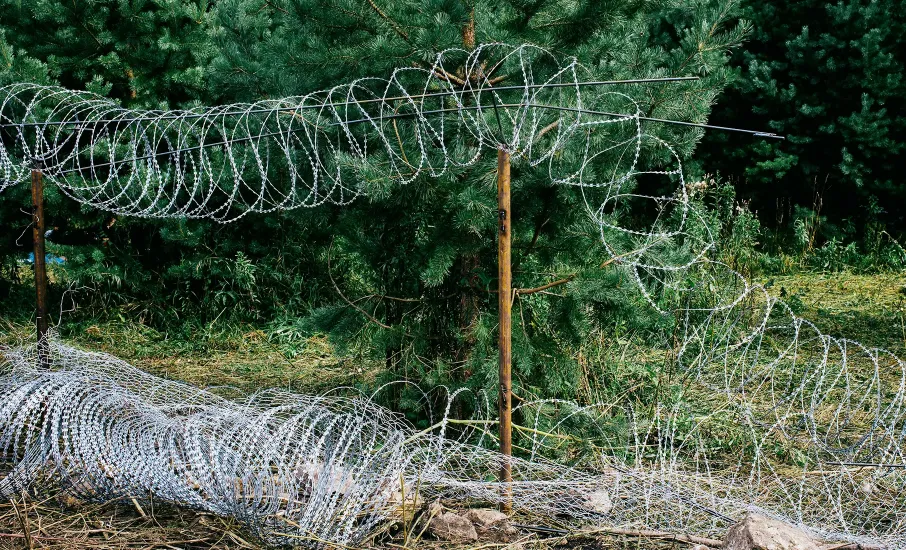
Egoza concertina wire must be fixed so that it preserves its working diameter and does not lose shape after installation. Brackets, supports, tensioning elements, wire, clips or other components are used depending on the type of fence. If the coil is installed on top of a fence, it is important to select the correct spacing between fastening points and avoid overstretching. An overstretched coil loses density and, with it, part of its protective properties.
For sites with increased security requirements, larger diameters, reinforced brackets, additional rows or separate supports may be used. In military, restricted-access or infrastructure contexts, concertina wire may function as an Egoza barrier line, so installation stability is especially important. The barrier must be not only visible, but also structurally stable, so that it is difficult to move, press down, cut or bypass through poorly protected sections.
Installation of Flat Barriers and Razor Mesh
An Egoza flat barrier is installed where the fence must be reinforced without significant projection beyond its plane. The main installation requirement is uniform fastening of the section along its full length, so that the barrier does not deform, move away from the base or create gaps through which it can be bypassed or pulled aside. For gates, pedestrian gates, sectional fences and areas with limited space, correct selection of height, fastening spacing and the method of joining individual elements is especially important.
Egoza razor mesh requires correct panel tensioning and reliable fixing of the edges. If the mesh is used to reinforce the fence plane, it must either fit evenly against the structure or be fixed on a separate frame. If it is used for protection against digging under the fence, the embedding depth, lower edge fixing and compatibility with the soil on site must be considered. In every case, the aim of installation is the same: the mesh must form a stable protective contour, not merely serve as a formal addition to the fence.
Typical Mistakes During Egoza Installation
The most common mistake is installing the barrier without assessing the condition of the main fence. If the supports are weak, the sections are unstable or the upper part of the fence is not designed for additional load, even high-quality Egoza will not provide the required result. Another problem is incorrect stretching of the coil. When it is stretched too much, coil density decreases and the barrier becomes easier to cross. If the coil is fixed unevenly, sagging, displacement and weak sections appear.
The importance of components is also often underestimated. Brackets, clips, wire, clamps and other elements must correspond to the barrier type and the loads on the site. Saving on fastening may lead to the barrier quickly losing shape or requiring repeated repair. Work safety must also be taken into account separately: razor wire has cutting elements along its entire length, so installation must be carried out with protective equipment, proper tools and correct organization of the work area.
Installation Cost and Ordering of Egoza Barriers
The cost of installing Egoza barriers is calculated individually. It depends on the product type, perimeter length, installation height, condition of the existing fence, number of brackets, difficulty of access to the section, need for additional supports, scope of work and the location where the work is carried out. For an accurate calculation, the perimeter structure must be understood, so the initial parameters are clarified first, and only then the installation scheme and configuration are selected.
To order Egoza with installation or receive advice on mounting, it is necessary to provide the basic site data: perimeter length, fence type, desired barrier type, installation height, location and protection requirements. Based on this information, concertina wire, a flat barrier or razor mesh can be selected, and the required quantity of products, components and installation work can be calculated. Fensys manufactures Egoza barriers in Ukraine and helps select solutions for industrial, infrastructure, restricted-access, commercial and private sites.