What Is Egoza Razor Mesh
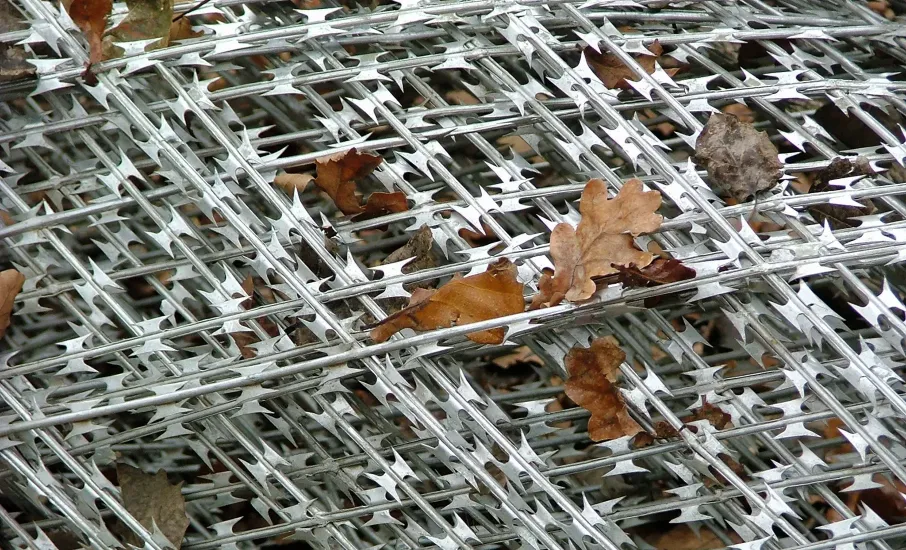
Egoza razor mesh is a flat protective barrier made of razor wire, in which separate strands are arranged in parallel and connected to one another with clips in a staggered pattern. When stretched out, this construction forms diamond-shaped cells, creating a dense barrier with cutting elements across the entire plane. Unlike ordinary mesh or simple barbed wire, Egoza razor mesh does not merely mark the perimeter line, but significantly complicates attempts to climb over, cut through or cross the barrier.
This type of product belongs to the general group of Egoza barriers, but has its own area of application. While Egoza concertina wire creates a three-dimensional barrier on top of a fence or on separate supports, razor mesh forms a flat protective panel. It can be used to reinforce existing fences, create new perimeter structures, block separate sections of a perimeter or protect the lower part of a fence against digging.
Construction of Egoza Razor Mesh
The basis of razor mesh is Egoza razor wire, made of a steel core and razor tape with cutting elements crimped around it. Separate strands are placed in parallel and then connected with metal clips at a defined spacing. This connection pattern forms the characteristic mesh structure with diamond-shaped cells, which retains its shape after installation and distributes the protective elements evenly across the entire barrier plane.
The mesh parameters can be selected according to the task: section height, section length, razor wire type, cell density and fastening method. For stationary use, material strength, clip quality, corrosion protection and correct panel tensioning are important. If the mesh is used as part of comprehensive protection, it can be combined with other Egoza solutions, including concertina wire or a flat barrier.
Where Egoza Razor Mesh Is Used
Egoza razor mesh is used on sites where it is necessary not only to reinforce the upper part of a fence, but also to protect the plane of the perimeter. It is suitable for industrial areas, warehouses, logistics sites, construction sites, technical zones, municipal facilities, restricted-access territories and locations where an extended flat barrier is required. Thanks to its mesh structure, the barrier works well on long sections where a large area must be protected without installing three-dimensional coils along the full height.
A separate application is protection against digging under the fence. Razor mesh can be partially embedded in the ground or used in the lower part of the fence if there is a risk of attempts to enter beneath the perimeter line. This method does not replace engineering reinforcement of the foundation, but it significantly complicates unauthorized access through the lower part of the perimeter. For sites with difficult terrain or long fence lines, this can be a practical addition to the main security system.
Razor Mesh, Concertina Wire or Flat Barrier
Egoza razor mesh is not a direct replacement for concertina wire. Concertina wire creates a three-dimensional barrier and is usually better suited for reinforcing the upper part of a fence when a strong deterrent effect and high difficulty of crossing are required. Razor mesh, by contrast, works as a flat panel, so it is appropriate for protecting the fence plane, blocking sections, reinforcing the lower part of the perimeter or creating an extended barrier with diamond-shaped cells.
Compared with an Egoza flat barrier, razor mesh covers a larger area and can be used not only at the top of a fence, but also across a significant height of sections or near the ground. A flat barrier is better suited for compact reinforcement of an existing fence, while mesh is intended for creating a separate protective panel. Therefore, the choice between these solutions depends on which part needs protection: the top of the fence, the fence plane, the lower part of the perimeter or a separate technical passage.
Installation of Egoza Razor Mesh
The effectiveness of razor mesh depends on correct tensioning, fastening and joining of sections. The panel must be fixed so that it does not sag, create weak zones or lose shape under wind, precipitation or mechanical load. Metal supports, sectional frames, brackets, clips, wire, clamps and other elements selected for the specific fence type or separate structure may be used for installation.
If razor mesh is installed on an existing fence, it is necessary to take into account the strength of the base, section height, the possibility of reliable edge fastening and the method of joining adjacent panels. When the mesh is used for protection against digging, the embedding depth, fixing of the lower edge and compatibility with the soil on site should be considered in advance. General principles of perimeter preparation and fastening selection are described on the page about installation of Egoza barriers.
Price and Ordering of Egoza Razor Mesh
The price of Egoza razor mesh is calculated individually because it depends on section height and length, razor wire type, cell density, number of clips, order volume, delivery conditions and whether installation is required. For sites requiring individual calculation, a universal price without specifying the parameters does not provide an accurate understanding of the cost, because different perimeter sections may require different heights, fastening methods and configurations.
To buy or order Egoza razor mesh, it is necessary to define the length of the section, the desired barrier height, the type of existing fence or supports, delivery location and the need for installation. Based on these data, the appropriate construction can be selected, the required quantity calculated and a proposal prepared. Fensys manufactures Egoza barriers in Ukraine and helps select solutions for industrial, infrastructure, restricted-access, commercial and private sites.