What Is an Egoza Mobile Barrier
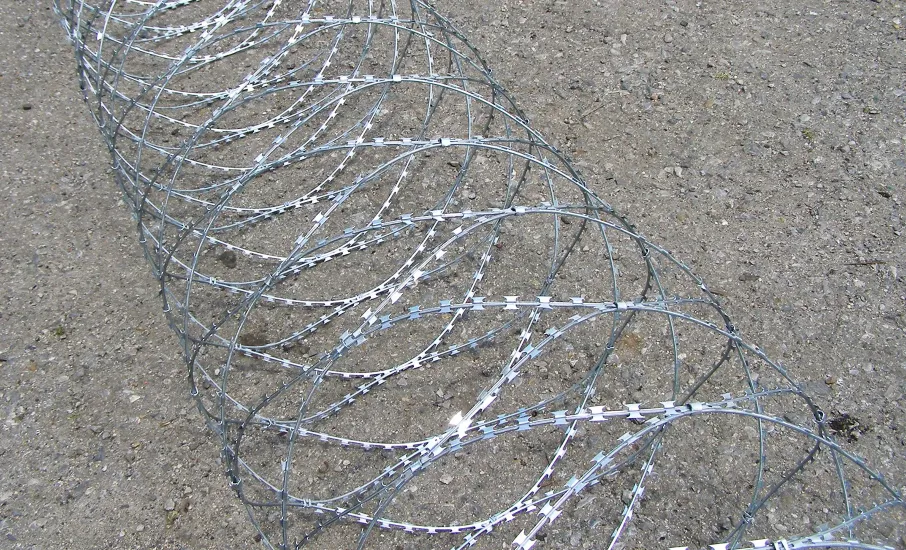
Egoza mobile barrier is a protective barrier based on Egoza concertina wire, designed for rapid deployment in areas where temporary access restriction is required. Unlike stationary barriers mounted on fences or separate supports, a mobile structure is designed for transport, storage, repeated use and installation without rebuilding the entire perimeter. Such solutions are used to block passages, entrances, technical zones, sections of construction sites, temporary security lines and other areas where fast response is important.
By purpose, a mobile barrier belongs to the general group of Egoza barriers, but differs in the way it is used. While Egoza concertina wire is usually installed as a stationary perimeter security element, a mobile barrier is needed where the site configuration may change, access must be restricted for a certain period, and after the work or event is completed the barrier must be folded, moved or used again.
Construction of an Egoza Mobile Barrier
The basis of a mobile barrier is concertina wire made of Egoza razor wire, fixed on a metal frame or a special supporting structure. In the folded position, such a barrier takes up relatively little space, which simplifies storage and transportation. After deployment, the Egoza concertina wire forms an extended protective obstacle that makes passage through the controlled area more difficult and creates a visible deterrent effect.
The specific construction depends on the intended use of the mobile barrier. For manual deployment, compactness, controllability, frame stability and the ability to quickly move the barrier from transport position to working position are important. For longer sections, solutions may be used that allow an extended barrier to be deployed with the help of a vehicle or special trailer systems. In any case, the key factors are the strength of the razor wire, stability of the structure after deployment and safe organization of work during installation.
Where Egoza Mobile Barriers Are Used
Egoza mobile barriers are used on sites where a stationary fence or permanent barrier does not fully solve the task. These may include construction sites, temporary warehouses, technical zones, emergency areas, entrances to a territory, passages between sectors, or perimeter sections during repair or reconstruction. Mobile barriers may also be used to organize temporary access-restriction lines on sites with increased security requirements.
A separate area of application is rapid blocking of passages and movement directions. In such cases, a mobile Egoza barrier makes it possible not to build a new fence, but to quickly create a physical obstacle exactly where it is needed at that moment. After the work, event or change of security regime is completed, the barrier can be folded and moved to another section. This makes the mobile barrier a practical solution for security services, industrial enterprises, infrastructure facilities, construction organizations and sites with temporary restricted-access conditions.
Mobile or Stationary Barrier
A mobile barrier does not replace a stationary perimeter security system where permanent protection of the territory is required. For the main perimeter of an industrial, warehouse, energy or restricted-access site, it is usually more appropriate to use stationary Egoza concertina wire mounted on a fence or separate supports. It is better suited for long-term use, uniform protection of the entire perimeter line and operation as part of a general security system.
A mobile barrier is appropriate when a separate section must be blocked quickly, a temporary line must be created, security must be reinforced during works, or access restriction must be organized without permanent installation. If a compact stationary solution for a fence is required, an Egoza flat barrier may be considered; if the fence plane or the lower part of the perimeter must be protected, Egoza razor mesh may be appropriate. The choice depends on whether the barrier must work permanently, temporarily or as an auxiliary element of comprehensive protection.
Deployment and Safe Use
An Egoza mobile barrier requires careful handling because its working element is razor wire with cutting elements. Before use, the deployment area must be defined, sufficient space provided, structural stability checked and the work organized so that accidental contact between personnel and the razor wire is avoided. For regular use, the procedure for storage, transportation, inspection and repeated deployment of the barrier should be planned in advance.
If a mobile barrier is used together with a stationary fence, connection points, end fixation, barrier visibility for personnel and the possibility of quick removal must be considered. For complex sites, it is advisable to define the mobile barrier use scheme in advance so that time is not wasted on improvisation when the barrier is needed. General principles of fastening and site preparation are described on the page about installation of Egoza barriers.
Price and Ordering of an Egoza Mobile Barrier
The cost of an Egoza mobile barrier is calculated individually because it depends on barrier length, coil diameter, razor wire type, frame construction, deployment method, configuration, order volume and delivery conditions. For such orders, it is important not simply to buy a barrier, but to select a structure that matches the actual use scenario: temporary blocking of a passage, reinforcement of a perimeter section, work on a construction site or rapid creation of a protective line.
To order an Egoza mobile barrier, it is necessary to define the section length, desired deployment method, transport conditions, place of use, frequency of use and storage requirements. Based on these data, the appropriate construction can be selected, the configuration calculated and a proposal prepared. Fensys manufactures Egoza barriers in Ukraine and helps select solutions for stationary, temporary and auxiliary perimeter security.